

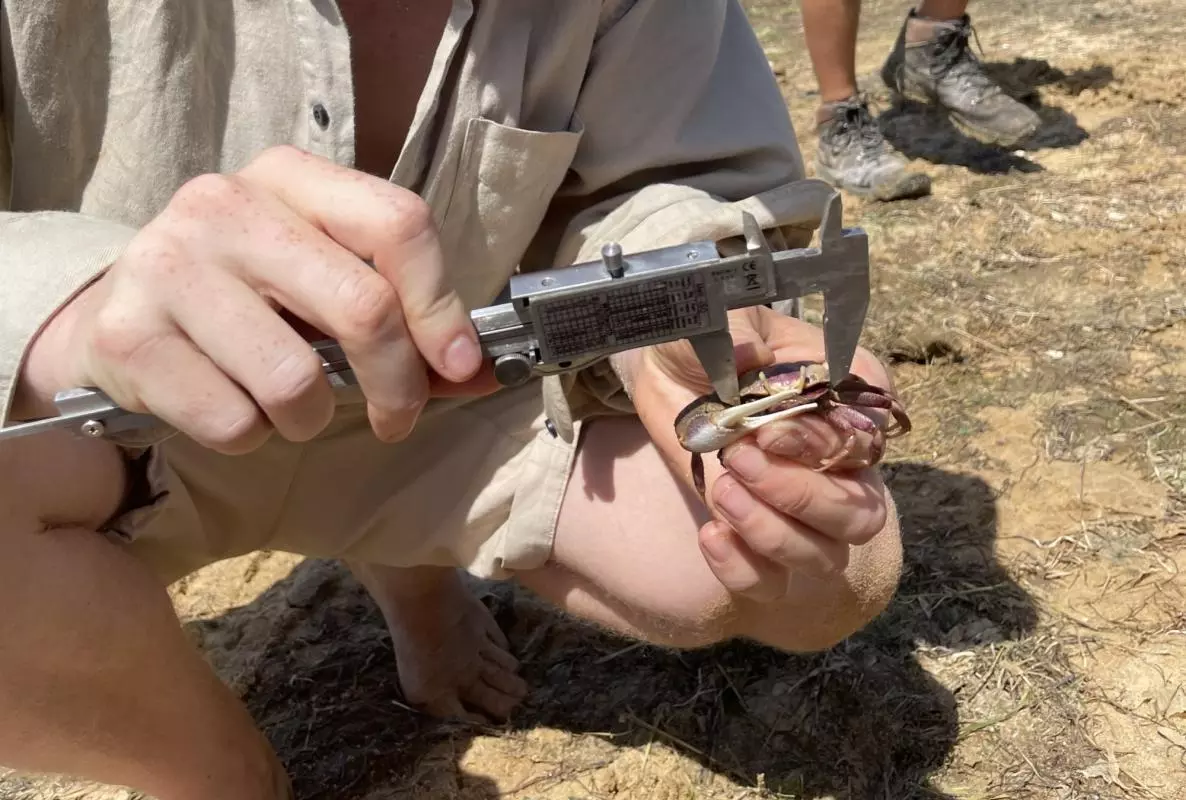
Male fiddler crabs are known to have multimodal courtship displays incorporating visual and vibrational signals to attract females. Yet very little is known about what seismic vibrational information is generated during courtship and how it is generated. Furthermore, we need to understand how biological factors such as male size and morphology and environmental factors such as seismic noise might affect courtship via seismic vibrations.
This project aimed to measure the seismic vibrations generated by wild fiddler crabs and correlate this with male behaviour, morphology and background noise. To do this, we used wired geophones deployed into the ground at different distances from the fiddler crabs and recorded their behaviour using cameras.
We found that behaviours that were more percussive generated seismic vibration of higher magnitude, with the most generated by the crab pounding the ground simultaneously with its claw and body. Behaviour did not influence the pitch or frequency of the vibration, which could be a benefit for transferring information as noise conditions change. Furthermore the males with larger claws generated vibrations with higher magnitude, so further studies should play back seismic vibrations to females to see what role this has in female choice of a mate.
Tom, DPhil StudentIt was remarkable to see how systematic these creatures were with each step of their courtship routines - visual, acoustic and seismic. In a way it reminded me of little robots taking pre-programmed steps.
Publications
Constraints on percussive seismic signals in a noisy environment by European fiddler crabs, Afruca tangeri
PROJECT TEAM


With thanks to Safi Darden and Joe Wilde for their support of the project.
This work was funded by a Company of Biologists travel grant and fellowship to Tom Mulder, who is also funded through a Natural Environment Research Council Case studentship with Save the Elephants as CASE partner, supervised by Dr Beth Mortimer and Prof. Fritz Vollrath and Dr Iain Douglas Hamilton.