
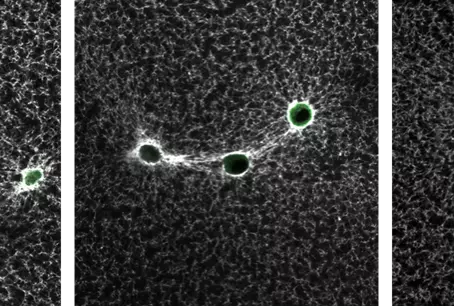
This project asks whether cells transmit information between each other using small motions, focusing on fibroblast cells that are important in humans for wound healing. Cells live within a bed of fibres and liquid known as a matrix, which has the potential to transmit motions through its network to other cells, similar to vibrations within a spiders' web. We know that fibroblast cells can generate forces, but we don't know if they transmit information through oscillations that vary over time.
The project aims to study the generation of these dynamic motions, how they move through the matrix where the cells are embedded and how the cells respond to these tiny motions. We do this by drawing together expertise from across biology and engineering, combining cutting-edge experimental techniques to measure cell-driven motions, and computer modelling to understand how cells generate and interact with these tiny motions.
Together, the project will give important insights into whether fibroblasts make use of motions for information. This is important for understanding how fibroblasts can influence and coordinate each other during important processes such as wound healing.
Tommi, Postdoctoral ResearcherDuring my studies, I became deeply fascinated in how sensory cells can code very soft vibrational/sound signals into electrical activity. Since then, I have been exploring how various cells in different animals achieve to do this and how animals use these vibrational signals to react to their environment."
PROJECT TEAM

This research is funded by the Human Frontiers Science Program via a Research Grant awarded to Dr Mortimer as Co-I (RGP016/2024), with Prof. Ayelet Lesman as PI and Prof. Ramón Zaera and Prof. Guy Genin as Co-Is.